AQF Level 5 Consulting Arborist - Melbourne & Victoria
Arboricultural Impact Assessments Melbourne
Council-ready arboricultural impact assessment reports for planning permits, development sites, subdivisions, renovations and construction works near trees.
Arboriculture Victoria prepares professional AIA reports that assess trees within and adjoining a development site, identify likely impacts and provide practical recommendations for tree retention, council approval and construction-stage tree protection.
Send through your site address, plans and any council correspondence
AQF Level 5 Arborist
AS4970-2025 Advice
Council Ready Reports
Melbourne & Victoria
Arboricultural Impact Assessment Reports for Planning Permits
An Arboricultural Impact Assessment, often called an AIA report, assesses how proposed development works may affect trees on or near a site.
These reports are commonly required by councils where buildings, driveways, services, demolition works, retaining walls or construction activities are proposed within the root zone or canopy area of protected trees.
Not sure what report council needs?
Send through your site address, planning drawings or council request and we can confirm what arboricultural information is likely to be required.
When is An AIA Required?
An Arboricultural Impact Assessment may be required where proposed works are near protected trees, neighbouring trees, council street trees, trees affected by a planning overlay, trees protected under a local law or trees affected by Clause 52.37 canopy tree requirements.
Planning Stage
New dwellings, extensions, subdivisions, townhouse developments and commercial development sites.
Construction Impacts
Driveways, crossovers, basements, retaining walls, services, demolition and site access.
Third-Party Trees
Neighbouring trees and council street trees where roots or canopy extend near proposed works

Ready to book a site inspection?
A site inspection allows us to collect the required tree data and prepare a report suitable for council submission.
TREE DATA, IMPACT ASSESSMENT AND RECOMMENDATIONS
What Is Included in an Arboricultural Impact Assessment?
Each report is prepared to provide council, owners, architects and builders with a clear understanding of tree constraints, proposed impacts and suitable protection measures.
Site Inspection
Species, height and canopy spread
Health, structure and condition
Arboricultural value
Development impact assessment
Tree numbering and identification
DSH and DAB measurements
Useful Life Expectancy
TPZ, SRZ and NRZ
Retention and removal recommendations
Avoid redesign and council delays
Get tree advice before finalising your design
An AIA is most valuable before architectural plans are finalised. Significant trees can influence building setbacks, driveway locations, basement design, service routes, excavation areas and construction access.
Early arboricultural advice can help avoid costly redesign, requests for further information and unnecessary conflicts with protected trees.
AS4970-2025 Tree Protection Advice
Arboriculture Victoria prepares Arboricultural Impact Assessments with reference to AS4970-2025, Protection of trees on development sites. Reports commonly assess Tree Protection Zones, Structural Root Zones, Notional Root Zones, root zone encroachment, canopy conflicts, excavation, ground protection, tree protection fencing and arborist supervision requirements.
TPZ
Tree Protection Zones used to guide construction setbacks and site protection measures.
NRZ
Notional Root Zones used to assess root zone impacts under AS4970-2025.
SRZ
Structural Root Zones used to assess potential stability impacts from excavation and root loss.
Arboricultural Impact Assessment reports for Melbourne councils
Arboriculture Victoria prepares Arboricultural Impact Assessments for planning applications across Melbourne and Victoria. We assist with arborist reports involving local tree controls, planning overlays, Clause 52.37 canopy tree requirements, Vegetation Protection Overlays, Significant Landscape Overlays, neighbouring trees and council street trees.
Whitehorse
Yarra Ranges
Mornington Peninsula
Stonnington
Glen Eira
Moonee Valley
Hobsons Bay
Manningham
Need a council arborist report?
Send through your council request, planning drawings or property address and we can confirm what is likely required.
Arborist Reports for Council Planning Permits
Arboriculture Victoria prepares arborist reports for council planning permit applications across Melbourne and Victoria. These reports are commonly required where proposed buildings, extensions, driveways, crossovers, subdivisions or demolition works may affect protected trees, neighbouring trees or council street trees.
Our Arboricultural Impact Assessment Process
1.Review Site Information
We review your site address, plans, survey and any council correspondence
2.Site Inspection
A consulting arborist attends the site to inspect and record relevant trees.
3. Tree Data Collection
Species, dimensions, health, structure, condition, ULE and arboricultural value are recorded.
4.Development Impact Assessment
The proposed works are assessed against TPZ, SRZ and NRZ calculations.
5. Council-ready report
You receive a professional arborist report suitable for planning submission or council response.
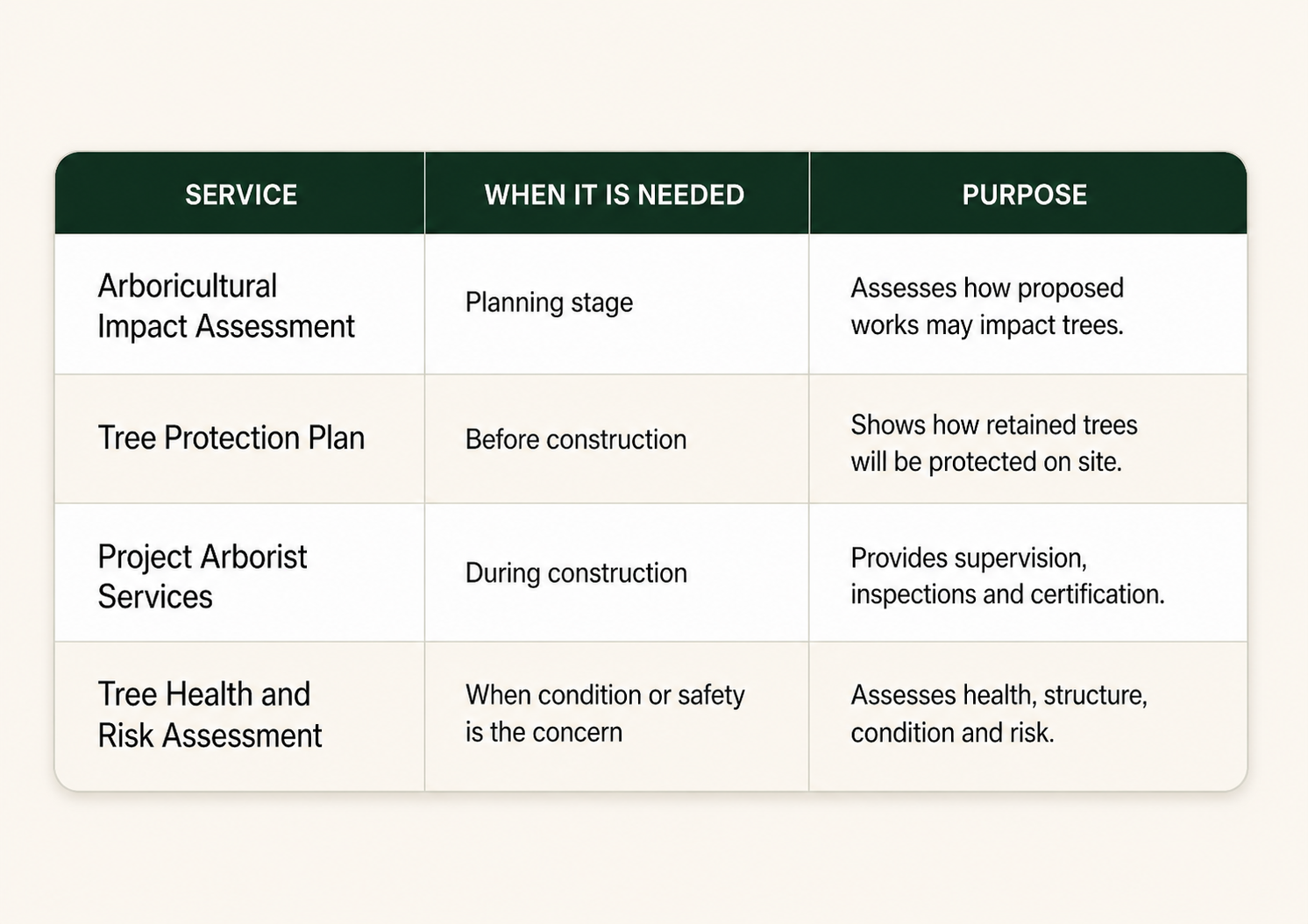
AIA Report vs Tree Protection Plan vs Project Arborist
Example AIA projects
Residential extension near neighbouring trees
Assessment of third-party trees where proposed works were located near a shared boundary.
Driveway works near council tree
Assessment of crossover works, excavation depth, root protection and arborist supervision requirements.
Multi-unit development with retained trees
Development impact assessment identifying tree protection zones and construction access constraints.
What happens after the AIA?
Depending on the site and permit conditions, you may also need Tree Protection Management Plans, Tree Protection Plans, project arborist inspections, tree protection fencing certification, excavation supervision, non-destructive root investigation or final compliance inspections.
Why Choose Arboriculture Victoria?
AQF Level 5 arborist advice, council-ready reporting, practical AS4970-2025 tree protection recommendations and clear communication with owners, architects, planners and builders.
Areas We Service
Arboriculture Victoria provides Arboricultural Impact Assessments throughout Melbourne and regional Victoria, including inner Melbourne, northern suburbs, eastern suburbs, bayside areas and regional growth areas.
Coburg
Mornington Peninsula
Yarra ranges
Frequently Asked Questions
-
You may need an AIA if your proposed works are near protected trees, neighbouring trees, council trees or trees affected by a planning overlay or local law.
-
A typical report includes tree data, health and structure assessment, ULE, arboricultural value, TPZ, SRZ, NRZ, impact assessment and recommendations.
-
Yes. Neighbouring and council trees may need to be assessed where roots or canopy extend close to proposed works.
-
Tree protection assessments are commonly prepared with reference to AS4970-2025, Protection of trees on development sites.
-
Yes. Arboriculture Victoria can provide inspections, supervision and certification where required by permit conditions.
-
The cost of an Arboricultural Impact Assessment depends on the number of trees, site complexity, available plans, council requirements and the level of development impact. A small residential assessment may be relatively straightforward, while larger development sites, subdivisions or projects involving neighbouring or council trees may require more detailed assessment and reporting. Arboriculture Victoria can provide a fixed fee once the site address, plans and assessment scope are reviewed.
-
Turnaround times depend on the size of the site, the number of trees and the complexity of the proposed works. For many residential projects, the site inspection and report can usually be completed within a practical timeframe once plans and site access are available. More complex sites, large tree populations, or projects requiring non-destructive root investigation may take longer.
-
You may need an Arboricultural Impact Assessment if your proposed works are close to a neighbouring tree, particularly where excavation, demolition, new footings, driveways, crossovers, retaining walls or level changes occur within the tree’s calculated root zone. Councils often require neighbouring trees to be assessed where development may affect their health, stability or long-term retention.
-
An Arboricultural Impact Assessment may be required where proposed works are close to a council street tree. This is common for new crossovers, driveway alterations, service trenching, demolition, boundary works or construction near the front of a site. The report can assess potential impacts and recommend tree protection measures in accordance with AS4970-2025 and council requirements.
-
Yes. An Arboricultural Impact Assessment can help support a tree removal application where removal is justified by the tree’s condition, low retention value, structural defects, poor useful life expectancy, site constraints or unavoidable development impacts. The report should provide clear arboricultural reasoning and, where required, replacement planting recommendations.
-
An Arboricultural Impact Assessment is generally prepared during the planning or design stage to assess how proposed works may affect trees. A Tree Protection Management Plan is usually prepared for the construction stage and provides practical tree protection measures, including fencing, ground protection, supervision requirements and hold points for works near trees.
-
Useful information includes the site address, feature and level survey, architectural plans, demolition plans, proposed driveway or crossover plans, civil plans, landscape plans and any council correspondence. If all plans are not available, a preliminary arboricultural assessment can still help identify tree constraints before the design is finalised.
-
Yes. Early arboricultural advice can help identify which trees are most suitable for retention, where root zones may constrain development, and how the design can be adjusted to reduce impacts. This can reduce redesign, avoid unnecessary conflict with council, and improve the chances of a smoother planning process.
Our AIA Process
Need an Arboricultural Impact Assessment Report?
Send through your site address, proposed plans and any council correspondence, and we’ll confirm the most suitable report for your project.