Arboricultural Impact Assessments in Melbourne and Victoria: What They Are and When You Need One
If you’re planning a new build, extension, subdivision, multi-unit development, or even a driveway/crossover change in Melbourne, you’ll often be asked for an Arboricultural Impact Assessment (AIA). This report explains how the proposed works will affect trees on-site and nearby (including street trees and neighbours’ trees), and sets out practical measures to retain and protect them during construction.
In Victoria, AIAs have become even more important as planning controls increasingly focus on tree retention and replacement—especially in residential zones where Clause 52.37 (Canopy trees) may apply.
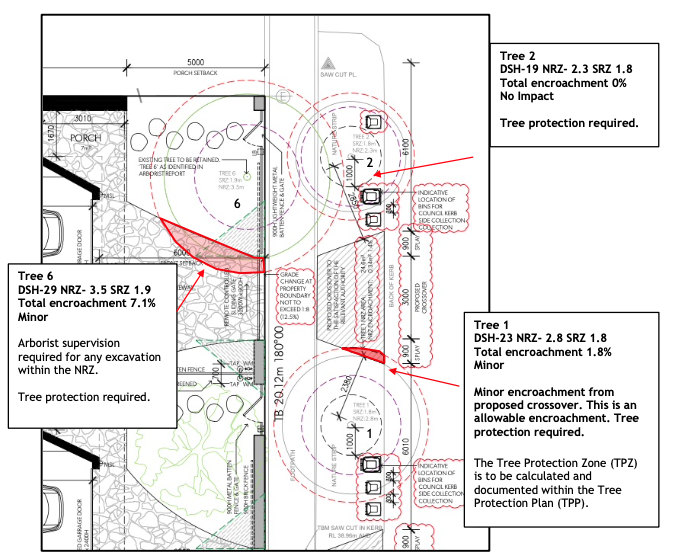
Example of an Arboricultural Impact Assessment (AIA)
What is an Arboricultural Impact Assessment (AIA)?
An Arboricultural Impact Assessment is a planning and design support document prepared by a qualified consulting arborist. It typically:
Identifies and assesses relevant trees (health, structure, retention value, useful life expectancy)
Calculates Tree Protection Zones and other protection areas (as applicable)
Measures how proposed works interact with those protection areas
Rates the impacts (minor/moderate/major) and explains tree viability
Recommends tree protection measures (fencing, ground protection, supervision, root investigations)
Supports a planning application and helps the design team reduce risk and redesign early
In plain English: it tells council what trees matter, what the design does to them, and how you’ll protect them.
When do you need an AIA in Melbourne and across Victoria?
You may need an AIA when any of the following apply:
Planning permit trigger: a permit is needed for buildings/works and trees are present or nearby
Clause 52.37 (Canopy trees): canopy trees in residential zones may require a permit to remove/destroy/lop in specified circumstances
Council tree local laws / overlays: local laws, Vegetation Protection Overlays, Significant Landscape Overlays, Heritage Overlays, etc.
Street tree impacts: crossovers, service trenches, driveway realignments, or frontage works near council trees
Neighbouring trees: construction near boundary trees where roots/canopies may be affected
Even if your architect believes the design “misses the tree,” councils often still want an arborist to confirm the actual risk to roots and structure.
Clause 52.37 in Victoria: why it changed the game for residential projects
In Victoria, Amendment VC289 introduced Clause 52.37 (Canopy trees) across planning schemes (from 15 September 2025) to strengthen canopy retention in residential areas.
Many homeowners are surprised to learn that a planning permit may be required to remove or heavily prune a canopy tree, even where there is no vegetation overlay. Councils provide summaries of how the clause works and how a “canopy tree” is defined.
What this means for your AIA: your report should clearly identify whether trees meet the canopy-tree definition and demonstrate:
retention has been prioritised where feasible
impacts have been avoided/minimised through design
if removal is proposed, why it is unavoidable (and what replacement planting is proposed where required)
The Australian Standard: AS 4970:2025 (Protection of trees on development sites)
Most Melbourne councils and private certifiers expect tree protection advice to align with AS 4970-2025 (the current standard for protecting trees on development sites).
A strong AIA in Victoria should use the standard’s framework to explain:
how protection distances/areas are derived
how impacts are measured and categorised
what construction methods reduce root damage risk
what site controls are required (fencing, signage, mulch, ground protection, supervision)
If your project is heading toward a permit application, an AIA that is clearly aligned to AS 4970:2025 helps reduce back-and-forth with council planners.
What a “council-ready” AIA report should include
A high-quality Arboricultural Impact Assessment for Melbourne/Victoria usually includes:
Tree inventory and assessment
species, size metrics and structure (with photos)
health, structural condition, and retention value
notes on constraints (past impacts, site history, existing paving/slabs)
Plan-based impact analysis
a clear summary of proposed works (buildings, driveways, pools, services, levels)
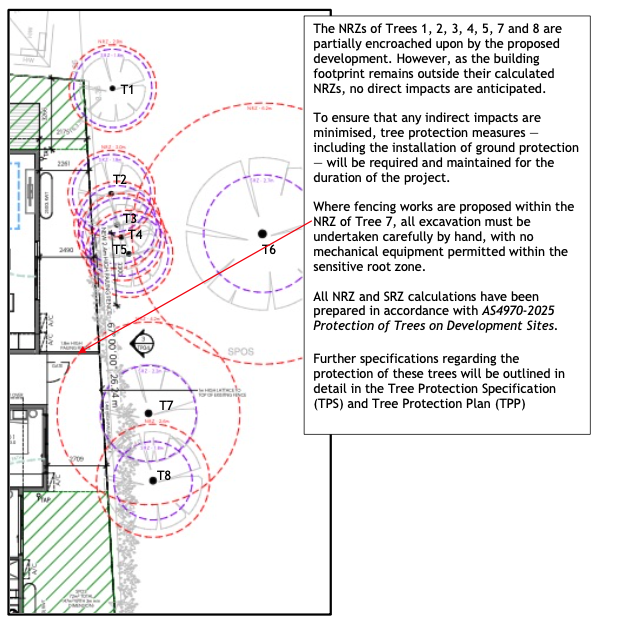
tree protection areas overlaid on plans (TPZ/SRZ/other nominated protection zones)
quantified encroachments with plain-language interpretation of risk and viability
Practical tree protection recommendations
Tree Protection Zone fencing specifications
ground protection where access is unavoidable
supervision requirements for works near trees
root investigation methods where design conflicts exist
site rules: storage/exclusion zones, washout control, changes to levels, etc.
A clear path to compliance
The best AIAs don’t just identify problems—they give your designer and builder a workable pathway to meet planning requirements while protecting valuable trees.
Common reasons councils request “revisions” to an AIA (and how to avoid them)
In Melbourne, AIA revisions are usually requested when reports:
don’t clearly show tree protection areas on plans
don’t quantify impacts (or downplay impacts without evidence)
don’t address street trees and frontage works
don’t align recommendations to AS 4970:2025
don’t explain alternatives (design changes) where major impacts are proposed
don’t address Clause 52.37 triggers where relevant
Tip: Include a concise “Impact Summary” section early in the report: tree-by-tree outcomes (retain/remove), permit triggers, and the key protection controls.
How an AIA can save time and money on your project
An AIA isn’t just paperwork. Done early, it can help you:
avoid redesign late in the permit process
prevent costly root damage during construction
reduce disputes with neighbours over boundary trees
keep builders out of trouble with street trees and council assets
protect mature trees that add resale value and amenity
For multi-unit developments, it can also support broader project documentation like a Tree Protection Plan (TPP) and Tree Protection Specification Plan where councils request detailed construction-phase controls.
Choosing a consulting arborist in Melbourne: what to look for
For planning submissions, look for an arborist who:
regularly prepares AIAs for Melbourne councils and understands local expectations
writes clear, planner-friendly reports (not just technical notes)
can coordinate with designers on root-sensitive construction options
can provide supporting documents if required (TPP, protection specs, certification, site supervision)
Some councils and industry guidance also highlight that AIAs should be prepared by suitably qualified consulting arborists, and be written to integrate with the design process rather than act as an afterthought.
AIA checklist for clients (architects, designers, homeowners)
Before we start, try to have:
current architectural plans (site plan + floor plans + sections/elevations if available)
demolition plans and proposed levels (cut/fill)
driveway/crossover details and any service layouts
feature survey (preferred) showing existing trees and site constraints
any council tree information you already have (street tree IDs, past permits)
The better the inputs, the faster and more accurate the AIA.
Frequently asked questions about Arboricultural Impact Assessments in Victoria
Do I need an AIA for a home extension?
If there are trees on or near the property (including street trees), councils often require an arborist report—especially where planning triggers apply or canopy trees may be impacted under Clause 52.37.
What is a “canopy tree” in Victoria?
Clause 52.37 sets out definitions used across Victorian planning schemes, and councils provide guidance pages summarising these definitions and what triggers a permit.
Is an AIA the same as a Tree Protection Plan (TPP)?
Not exactly. An AIA assesses impacts and recommends measures. A TPP is typically the plan/drawing package (often prepared once designs are final) showing the tree protection controls to be implemented on-site.
Does AS 4970 matter for my permit?
Yes—AS 4970-2025 is the recognised Australian Standard for tree protection on development sites and is commonly referenced as the basis for methodology and site controls in arborist reporting.
Need an Arboricultural Impact Assessment in Melbourne or Victoria?
If you’re preparing a planning application and need an Arboricultural Impact Assessment (AIA) that is clear, council-ready, and aligned to AS 4970-2025, it’s worth engaging a consulting arborist early—ideally before plans are locked in.
Call Now - Email Us
To request an Arboricultural Impact Assessment in Melbourne or regional Victoria, contact Arboriculture Victoria for a fee proposal and lead time. Include your site address and latest plans for a fast quote.